By Danielle Krikorian, University of Birmingham
Where is displacement located in art? How can this location serve to display the memories of displacement – particularly in the Arab world?
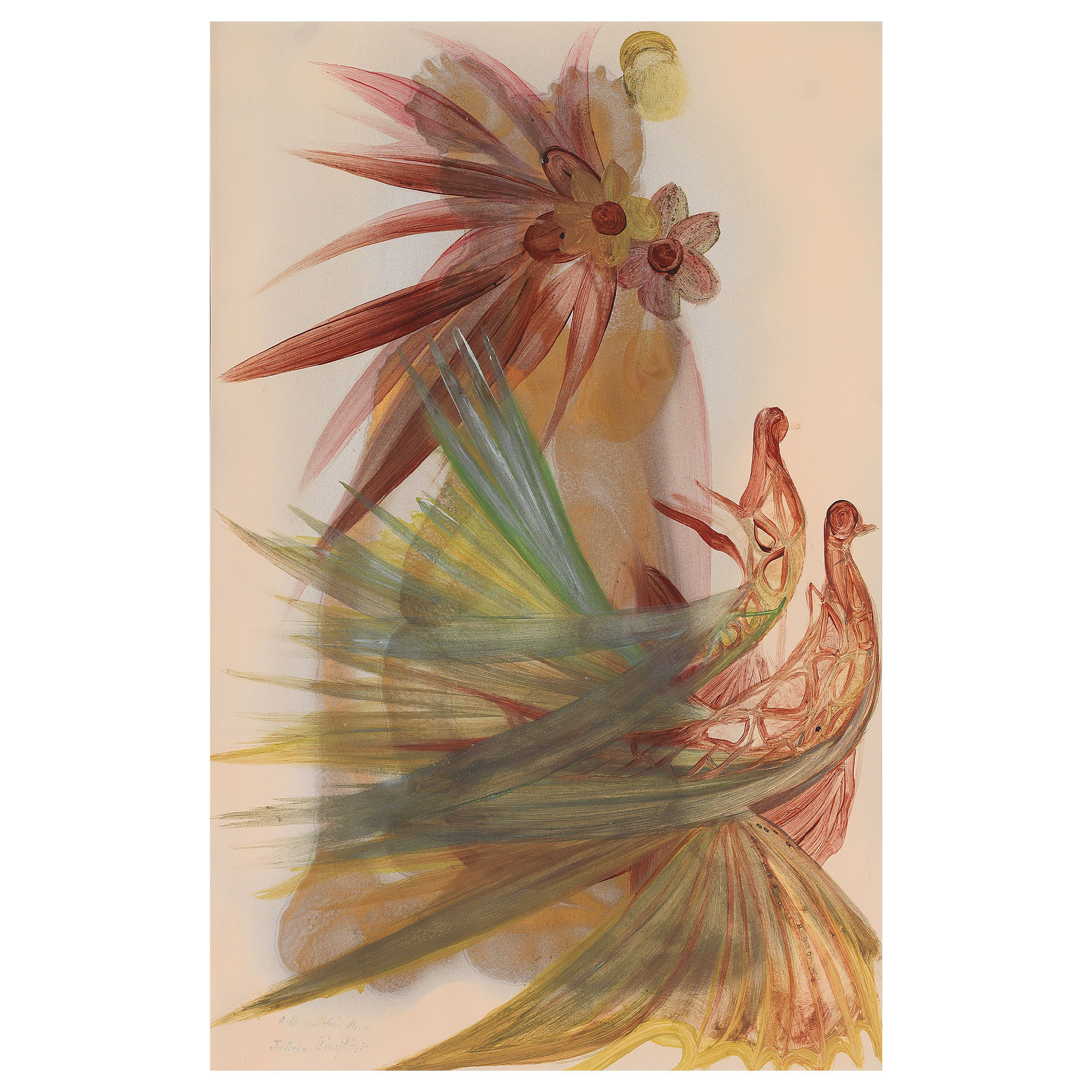
In the Middle East, displacement was the consequence of historical and political dispossession as a result of colonialism (Akram, 2018, 415). During World War I, France and Britain divided the Mediterranean territories under Ottoman Empire occupation with Palestine becoming Mandatory Palestine under British Mandate. In 1948, the Israeli army forced the displacement of Palestinians, which is referred to as the Nakba (in Arabic the term literally means ‘the catastrophe’). It is in this perspective that Palestinian artist Juliana Seraphim produces works representative of her own experience of the Nakba. The Seraphim family fled Jaffa (Yāfā in Arabic) in 1948 when it was invaded by the Israeli army. They were exiled in Lebanon (Boullata, 2005). Her work Untitled (1970) will serve as a window into exploring these questions.
Visual displays of time are the vehicle through which memories are embedded. In Seraphim’s watercolour-on-paper Untitled (1970), surreal figures float, their bodies made of vine-like ligaments that transform into wings. They are seemingly in transition. This space of transition in Seraphim’s work represents the Palestinian experience of displacement. Ashutosh Singh writes that the deprivation of their land and exile has created a complex Palestinian experience (Singh, 2019, 318). Yearning for a homeland and independence from occupation is expressed textually and visually. Moreover, it has shifted the Palestinian experience of time, from pre-occupation to occupation within their homeland, and outside of it. Their time is defined by exile and an ever-present waiting. Waiting has become a core part of the Palestinian existence, seeping into everyday life. Palestinian identity is linked to language, connection, and the collective identity of waiting. It is also rooted in an imagined collective and national homeland (Singh, 2019, 318). In this way, Seraphim’s work visually expressed the yearning and departure from the homeland, through the floating of the figures. It also represents Palestinians’ understanding of time in displacement in a constant state of waiting following the Nakba. The figures themselves are placed against a monochrome beige-pink background that highlight their uprooting.
Furthermore, art represents the memory of this displacement, and the waiting, through movement. Untitled is both detailed in certain areas through strokes and thin lines, yet purposefully blurred around the wings, and one of the figures. This effect gives the illusion of a memory, both close and distant. According to Sajjad Gheytasi, people who have been through displacement see the past as being integral to their present, and how they traverse the difficulties within it. The stories become part of their countenance. The relationship between the future, the past and the present is a dialectical one in which past struggles are used to contextualise the present, and to encourage dreams of the future (Gheytasi, 2024, 18). In the Palestinian context, this purposeful engagement and refusal to forget is an act of resistance through the reclaiming of narratives, against historical and cultural erasure (Gheytasi, 2024, 19). Transferring memories and remembrance of Palestine’s turbulent history is an affirmation of identity and homeland (Gheytasi, 2024, 21). Seraphim’s work encapsulates the past and memories of the Nakba into the present. The stories of departures from place to place become the lens through which Untitled functions by reclaiming the narrative. Certainly, the movement, the details, and the blurred part within the work showcases the dialectical relationship between the past, the memories of displacement, struggles and dreams in the present, and future. By visually depicting this dialectical relationship, the artist conveys the memories to the viewers.
The Levant has Byzantine and Islamic heritage (Krikorian, 2022, 52), which Seraphim’s work is part of. The patterns and details are reminiscent of the patterns seen in this cultural heritage. Art has symbolic meaning, which is meant to trigger memories, and thus memories of displacement through culture. According to Jan Assmann, memory occurs not only within human interaction but also between human and non-human symbolic interaction. This includes representations, images, texts, narratives, landscapes. Interactions with these objects may elicit a memory with which people have associated them (Assmann, 2019, 111). Seraphim’s artwork both symbolises her memory of displacement and of Palestinian culture. The painting contains patterns and aesthetic representations that elicit the memory of a place, both as a point of forced departure but also of its significance to the artist, Palestinians, and the region. The flowers and earthly colours – beige, brown, green, and red – are symbols that inform, or trigger memories of what people may associate land to be, and what it means for them. In this case, it is the land from which Seraphim was exiled. Untitled visually transmits the artist’s personal memory of Palestine, and the wider context of displacement, movement, and recall.
In this way, the location of displacement in art and how memories of this displacement are expressed in artworks can be seen through the visual display used by an artist, and beyond. The memories and experience of the Nakba and displacement in Juliana Seraphim’s Untitled (1970) seep through the representation of suspension, movement, and symbolic memory triggers.
References:
Note: This research is part Danielle Andrea Krikorian’s Doctoral Research project ‘Patterns of Trauma’ at the University of Birmingham supported by Midlands4Cities (M4C) and AHRC.
Ashutosh Singh. (2019) ‘Time and Waiting: The Fulcrum of Palestinian Identity.’ Arab Studies Quarterly, 41 (4): 317-331.
Assmann, Jan. (2010) ‘Communicative and Cultural Memory.’ Cultural Memory Studies: An International and Interdisciplinary Handbook. Berlin. New York: De Gruyter,109-118.
Boullata, Kamal. (2005) ‘Art’ in Encyclopaedia of the Palestinians. New York: Facts on File.
Krikorian, Danielle Andrea (2022). ‘Shaping Space: Morphologies and Transitions in the Umayyad madīna ‘Anjar.’ Dar Journal: Le citta del mondo islamico (2): 51-62.
Sajjad Gheytasi. (2024) ‘Echoes of Exile: Rememory and Resistance.’ Arab Studies Quarterly 46 (1): 9-27.
Link to website: https://ansazura.com/en/artist/juliana-seraphim/untitled
Link to image: https://ansazura.com/media/catalog/product/cache/1/small_image/9df78eab33525d08d6e5fb8d27136e95/j/u/juliana_seraphim_1.1.jpg
 MeMiRe - A Discursive Glossary